
Acting Presidents
Courage, performance, and the moment that makes history - or not

Hello and welcome! My name is Davide, and I’m an Italian journalist who has been living and working in Kyiv for almost three years. For those of you visiting for the first time, here’s a bit more about who I am and what this space is. My last newsletter was an essay on how the so called “West” failed Ukraine. I hope you’ll find the following text engaging.
On February 25, former Spanish lieutenant colonel Antonio Tejero died at his home near Valencia. He became world-famous in 1981, when he stormed the Congress of Deputies in Madrid at the head of 200 Civil Guards during an abortive coup d’état. The assault was broadcast live on television and radio, and millions of people saw the colonel stride onto the podium, fire shots into the air, and order the entire parliament to lie on the floor.
Yet, Tejero, with his bushy mustache and his sergent-Garcia air, was far from the most colorful character in this drama. When the Civil Guards stormed the chamber and started shooting, only three people remained defiantly seated. One of them was the Minister of Defence, a proud general who looked down on the coup plotters as insubordinate children. The second was the leader of the Communist Party, who already knew that, had the plotters prevailed, he would have been a dead man walking.
The third and last man standing was the least expected of them. He was an ambitious upstart who rose from a provincial backwater to climb the ranks of the Francoist regime with flattery and smiles, until, by an absurd historical chance, he found himself at the helm of the regime just as it was time to bury half a century of dictatorship and transition to democracy. He was Spain’s first democratically elected prime minister, and his name was Adolfo Suárez.
In 2009, Suárez’s epic stand against the coup plotters became the subject of an book by Spanish author Javier Cercas, The Anatomy of a Moment. Beginning with the televised image of the entire Parliament cowering under machine-gun fire, while Suárez stood unperturbed as a living symbol of the firmness of the democratic order that would later prevail, Cercas aims to tell the story of the coup and how close it came to succeeding. In the end, he could not avoid being seduced by Suárez’s personality.
In the last chapter, which is the key to the entire book, Cercas draws a parallel between Suárez and a fictional figure from an Italian short novel later adapted into a movie by Roberto Rossellini. The protagonist of this story is Emanuele Bardone, a small-time swindler who, in the final days of the Second World War, is recruited by the Nazis to impersonate General Della Rovere, a leader of the Italian Resistance, and infiltrate a group of partisans inside a prison.
While there, Bardone slowly lost himself in the role. He stops acting like a leader of the Resistance and actually become one. In the end, when the Nazis threaten to kill him if he did not reveal what he had learned from the prisoners, Bardone chose to die as General Della Rovere, shouting “Viva l’Italia” in front of the firing squad.
According to Cercas, there is an unmistakable parallel between Suárez and Bardone. The former Spanish prime minister, too, was a peculiar type of swindler - one who operates in the halls of power, peddling flattery and compliments to anyone who could help his rise. Like any real conman, he truly had nothing else to offer but his smile and pleasant manner, yet in sufficient quantity to help him become the leader of the Francoist party. After the dictator’s death, he was not a likely candidate to succeed him. But he appeared pliable, unthreatening, and inclined to compromise. The king chose him for the job.
What few could have imagined at the time was that, once he was given the historical role of dragging Spain from a calcified dictatorship to a modern democracy, he would start acting upon it. He turned his talent for compliments and flattery into a tool for cajoling the military and conservatives. He had them accepting one giant leap after another: multi-party democracy, elections, and the legalisation of the Communist Party. But he was not merely using his talent for a different objective; he acquired the manner and the strength that his role required. When a general threatened him, saying that Spain was a country prone to military coups, he replied: «And I remind you, general, that in this country we still have the death penalty».
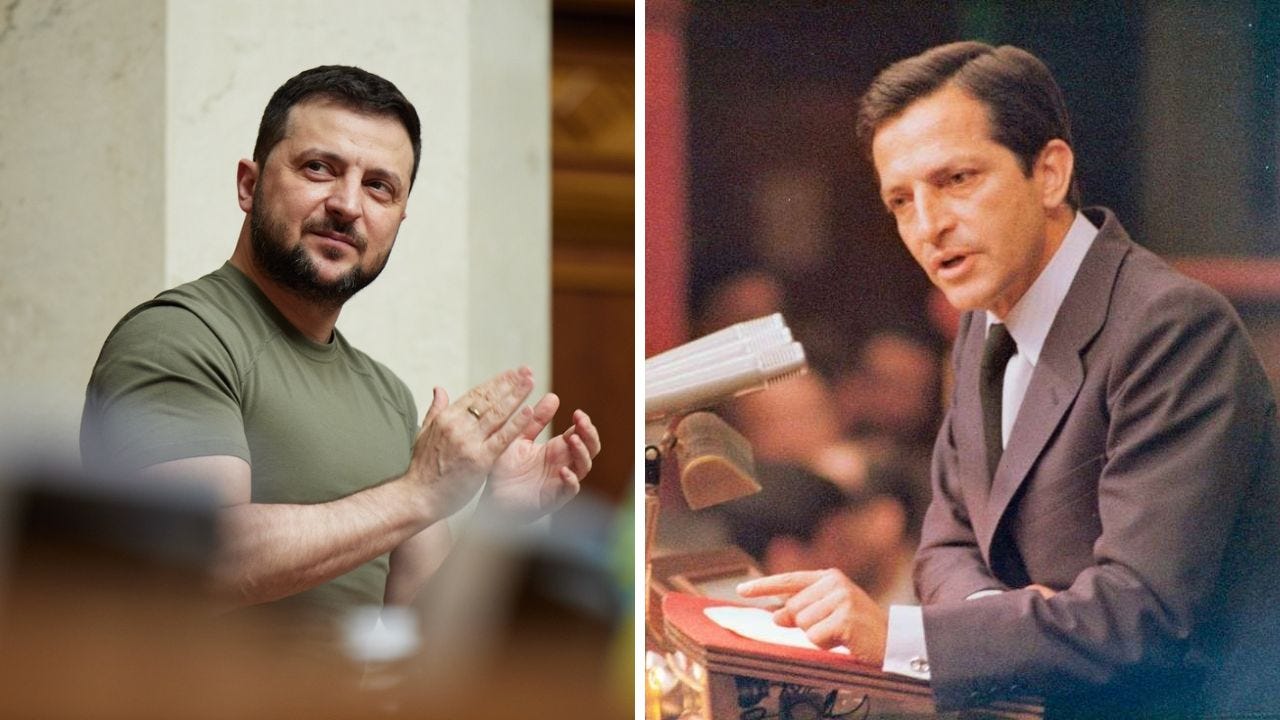
When Tejero burst into the Parliament, the sublime moment came for Prime Minister Suárez. Other men and women, smarter or with stronger conviction, might have hesitated. And many better than Suárez did, ducking under their desks at the first sound of gunfire. But Suárez did not. At that moment, as a true actor lost in his role, he felt that he was Spain itself; he felt that he was General Della Rovere. And he acted the part.
Last summer, as I was reading Cercas’ book, I could not avoid thinking about another figure who came from a provincial backwater, rose thanks to unheroic talent, and then, faced with an overwhelming challenge, amazed the world by standing up to it. Volodymyr Zelensky was born in Kryvyi Rih, the quintessentially anonymous post-Soviet rust city. A comedian with a rather coarse sense of humour, he was chosen to run for office by powerful oligarchs who sought to capitalize on Ukraine’s post-Maidan delusions after he had played the president of Ukraine in a TV series.
Elected on the most generic anti-corruption and reconciliation platform, he quickly lost the support he had won from the electorate. He did not fight corruption, could not reach a deal with Putin, and his ratings plummeted. As the threat of war grew closer, he did not believe it. If not for what followed, he would have been remembered by history for what he told his people on the eve of the invasion: «In summer you’ll be grilling in your garden. There will be no war».
War, however, came. For the first 24 hours, Zelensky was in shock. His first phone call was to British Prime Minister Boris Johnson, whom he asked to call Putin and urge him to stop the war. Looking back today at his first message to the Ukrainian people, in the early hours of the morning, he appeared much younger and nervous, still wearing a civilian suit and a white shirt, which made him look even more vulnerable and unsuited to the task.
Then, probably during the night, something snapped in him. Maybe it was the news from Hostomel Airport, where a hastily assembled Ukrainian counterattack managed to block the Russians from landing the troops that were supposed to advance into the city center. Maybe it was something else, something personal and secret. Certainly, it was not the support of his allies. The USA offered him an escape route, not weapons or aid.
Whatever it was, the night after the invasion, Zelensky appeared for the first time in what would become his signature green military fatigues. Holding the phone in his hand, his closest collaborators behind him, under the yellow light of the presidential courtyard, he proclaimed his challenge to the Russian invaders. «We are here - he said - We are defending our independence, our state, and we will continue to do so».
It made an enormous impression in the country and abroad. With his personal courage and stern rhetoric, he shamed even the most reluctant allies into sending support. The impact on Ukrainians is hard to overestimate, and it is still felt today. Many Ukrainians say that it was that speech, that choice, that made them believe they could resist, that they could fight back. Their president had been a third-rate comedian, a blunderer. But whatever his mistakes and shortcomings, Він не втік, Vin ne vtik. He did not run.
The double parable of Suárez and Zelensky shows that we need histrionic personalities to step into their roles as if we are all in a movie. Heroes are not real, and we need actors to play them in real life - whether on a cinema screen or in a parliament under siege. What they are not made for, however, is the daily slog of ordinary governance.
Suárez had his crowning moment at the very end of his career. The parliament Tejero assaulted was voting on Suárez’s successor, after the first democratically elected prime minister had presided over an ineffectual second term. Suárez’s career ended because democracies do not need heroes for their boring, day-to-day workings. After 23 February, Suárez was left with the role of the retired statesman—a part which, as ever, he played perfectly.
Zelensky’s defiant speech marked the beginning of his golden moment, and from then on his star kept rising. For more than a year, he built an ever-expanding coalition and presided over spectacular victories on the battlefield. Had events unfolded differently, Zelensky would have been a great victorious leader, capable of magnanimity and reconciliation. He would also have made a perfect martyr - and surely he would have played that part to the very end.
What he appears far less suited for is leading a country mired in an open-ended war of attrition, where mobilizing resources, long-term planning, conserving forces, and accepting bitter trade-offs matter far more than heroic grandstanding. Too elevated above the machinery of power to see what his advisers were doing behind his back and too distant from the suffering of his people in cities and trenches, his standing was gradually eroded.
History is rarely decided by heroic moments. Suárez standing firm behind his prime minister’s desk was a powerful symbol, but the failure of the coup was decided elsewhere. Yet those are the moments people remember.
However this war ends, Zelensky - like Suárez facing Tejero - will already have his finest moment behind him. And whatever mistakes he may still make, Ukrainians will remember him as the president who did not run. Heroes may not be real, but people need them nonetheless.
Thank you very much for reading. If you have the time, I strongly reccomend Anatomy of a Moment, one of those book that makes you wish to to write something like it at least once in your life. If you enjoyed this content, please consider liking, commenting, or subscribing. You can also follow me on X, where I frequently write in English. Once again, thank you!